LaGSplat: Latent Lagrangian Gaussian Splatting
À partir de vidéos d'un système dynamique, LaGSplat permet de créer une scène 2 ou 3D interactive vérifiant les équations de la physique.
experiment 1 · synthetic
Gaussians parameterised by the latent state
input
Filmed video
planar simple damped pendulum
current frame
4DGS · parameterised by t
Space-time volume
axes (x, y, t): the plane always moves to the right
drag to rotate
-
Gaussians tiling
the space-time volume
the space-time volume
LaGSplat · parameterised by q
Space-state volume
axes (x, y, q), q = angle θ: a helical manifold, the plane swings
drag to rotate
-
Gaussians tiling
the space-state volume
the space-state volume
experiment 2 · real test case
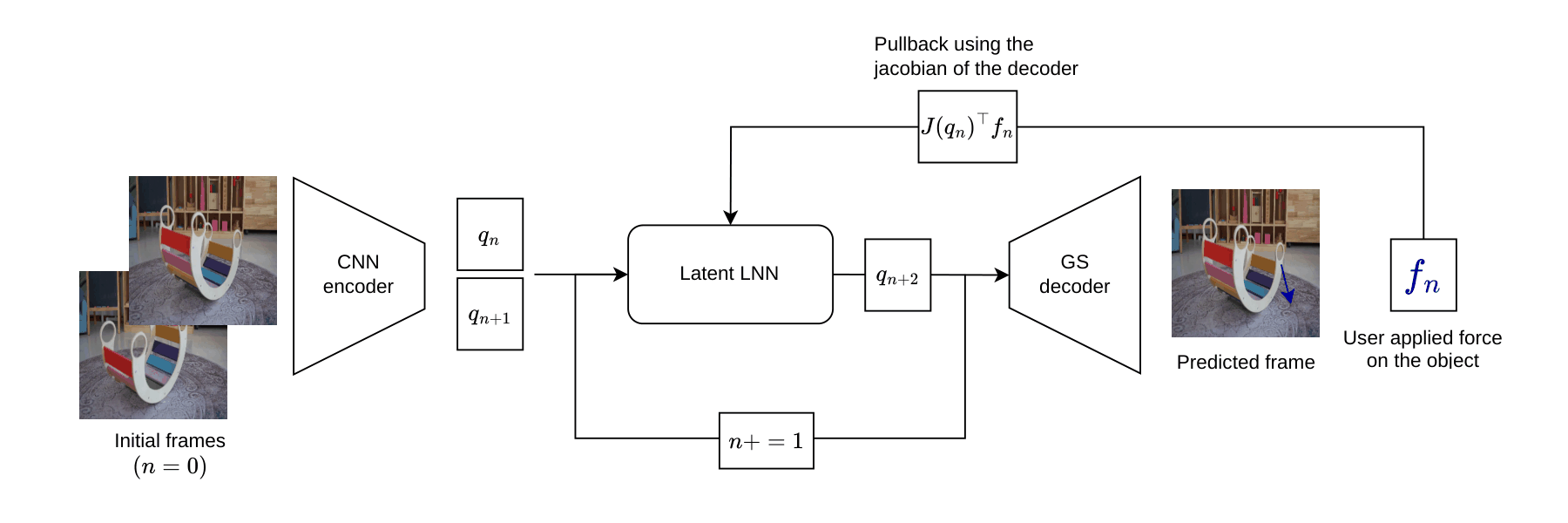
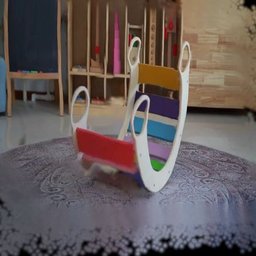
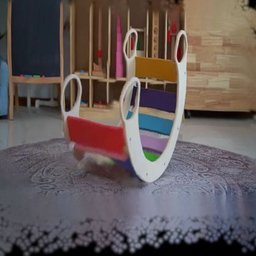
One-degree-of-freedom test case: an oscillating rocking chair
LaGSplat · learned gaussians
Space-state volume
axes (x, y, q): 2048 gaussians, the plane is the current state
drag to rotate
reconstruction from q
Reconstructed frame
model's RGB output, sliced at q = current
grab & drag the object
Grab the object: dragging applies a force, mapped through the decoder into the latent space and added to the LNN equation.
training video over


LaGSplat · 3D reconstruction
Interactive 3D scene
click the object to push it, click again to release · drag to rotate · scroll to zoom
experiment 3 · real test case
Two-degree-of-freedom test case: a bag hanging from its handle
LaGSplat · latent state
Trajectory in the latent space
axes (q₁, q₂): the 2-D state of the dynamical system; faint curve = trajectory in the training videos
drag the dot
See how the dynamical system evolves by sweeping the plane with drag & drop.
reconstruction from q
Reconstructed frame
model's RGB output, sliced at (q₁, q₂) = current
grab & drag the object
Grab the object: dragging applies a force, mapped through the decoder into the latent space and added to the LNN equation.